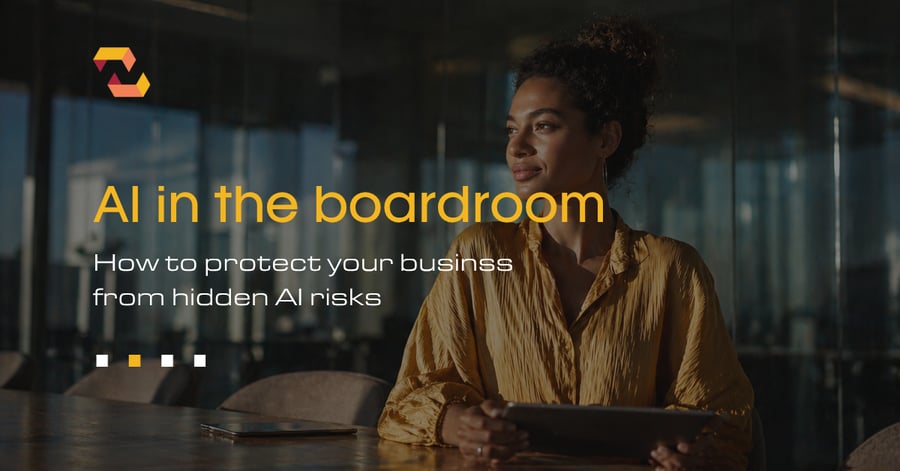
But here’s the truth: AI adoption isn’t just a technology decision anymore; it’s a governance and risk management issue.
Every executive who signs off on AI without proper controls assumes a level of liability that can’t be ignored.
Why executive liability is on the line
AI is business-critical now, but the fallout from mismanaged adoption can destroy brand equity and shareholder confidence overnight.
Consider what’s at stake:
- Legal compliance: Under GDPR and NIS2, boards can face fines up to €10 million for failing to protect sensitive data.
- Reputational risk: News of an AI breach can tank customer trust and market confidence in hours.
- Regulatory oversight: New AI governance frameworks (e.g., EU AI Act) are making boards explicitly accountable for misuse.
The big misconception? Thinking AI risk is an “IT thing.” It’s not. It’s enterprise risk.
The data you can’t ignore
- 56% of employees use unapproved AI tools without IT consent (Blackfog, 2026)
- 68% of organizations have experienced AI-driven data leaks (Metomic, 2025)
- AI-related incidents like Samsung’s proprietary code leak or Chevrolet’s rogue AI bot offer are no longer outliers; they’re a pattern
When these stories hit the headlines, shareholders don’t ask IT why. They ask the board how it was allowed to happen.
Why traditional risk frameworks fail with AI
Legacy governance models manage risk after technology implementations. AI flips that script:
- AI consumes, interprets, and generates sensitive information at scale
- Autonomous AI agents make decisions without human review
- Shadow AI adoption grows every day, creating blind spots your risk committee can’t see
Boards can no longer say, “We weren’t aware.” Regulators assume you are, and hold you accountable.
Want to see real-world AI attack scenarios and prevention strategies?
👉 Watch our on-demand session: Cybersecurity, AI & Copilot Protection for Microsoft 365
The executive playbook for AI governance
AI innovation doesn’t have to mean uncontrolled risk. But governance can’t be an afterthought; it must be a board initiative backed by strict ownership.
5 steps every leadership team must commit to:
Step 1: Define AI usage policy
Set boundaries for tools, prompts, and workflows at an organizational level.
Step 2: Map & classify your data
Apply Microsoft Purview sensitivity labels across Office 365 and Teams. You can’t protect what you don’t know.
Step 3: Enforce Data Loss Prevention (DLP)
Build rules to prevent leaks before Copilot ever touches critical information.
Step 4: Govern AI agents and access
Use Microsoft Entra for agent identity control and Defender for Cloud Apps to spot shadow adoption.
Step 5: Demand continuous oversight
Mandate 24/7 monitoring with Microsoft Sentinel and a Managed XDR team.
These measures translate governance from theory into measurable accountability.
What Nedscaper brings to the boardroom table
Adopting AI securely isn’t about adding “one more tool.” It’s about orchestrating existing investments, aligned with governance, compliance, and growth goals.
Our Microsoft-first model ensures:
-
- AI policy design that meets NIS2/GDPR-ready standards
- Integration of Purview, Entra, and Defender into a cohesive control framework
- Human-led SOC oversight because not every risk is in the dashboard

Ready to secure AI before risk hits?
AI adoption moves fast. Compliance and governance need to move faster. Don’t leave your organization exposed.
✔ Identify your hidden AI risks
✔ See where Microsoft 365 misconfigurations create leaks
✔ Get a clear roadmap for Copilot governance