Why AI policy is more urgent than ever
Many organizations recognize the rapid growth of AI usage but struggle with how to deploy it in a controlled manner. The instinctive response is often to restrict or temporarily block AI tools until all risks are fully understood. But that approach no longer works.
Employees will always look for ways to work more efficiently, and AI is one of the most attractive tools available. The result is predictable: employees turn to external AI tools without oversight, leading to Shadow AI and unnecessary security and compliance risks.
In today’s reality, it is clear that blocking is not a sustainable solution. What organizations need is a clear, practical, and widely supported AI policy that provides direction without slowing down innovation.
The pitfall of reactive action: waiting until something goes wrong
Many organizations delay defining AI policy until risks become visible. By the time those risks surface, however, the damage has often already been done, particularly when it comes to data processing.
AI tools draw on all available information, including unclassified or sensitive data that was never intended to be shared.
Because employees lack clear guidance on what is and is not permitted, unintentional risks emerge, such as:
- using unreliable or unassessed AI tools
- entering sensitive data into external systems
- consulting outdated or incorrect information
- bypassing existing security controls
At the core of the problem lies a simple reality: there are no rules of the game.
Why policy is the foundation of safe AI adoption
Strong AI policy creates clarity on three critical levels:
1. Clear boundaries
Policy defines which AI tools are permitted, which data labels AI is allowed to access, and which types of information must never be processed by AI. This drastically reduces the risk of unintentional data exposure.
2. Roles and responsibilities
Who approves new AI usage? Who manages risk? Who handles incidents? Explicitly defining these roles makes AI adoption manageable and predictable.
3. Process and decision‑making
Organizations need to know when an AI use case is approved, how monitoring is handled, and which steps are taken when deviations or incidents occur.
Effective policy is not a theoretical document; it is a practical guide that employees understand and can apply.
Technology reinforces policy, but never replaces it
Policy only works when it is supported by technology, such as:
- Data Loss Prevention (DLP) to block sensitive data
- SharePoint Advanced Management to exclude high‑risk locations
- Defender for Cloud Apps to monitor unauthorized AI tools
- Data classification to clearly define which data AI may access
However, technology is only one piece of the puzzle. Without a policy, employees do not know how to use AI safely. Without awareness, rules are not applied in practice.
The future of AI requires governance, not brakes
AI is not a temporary trend; it is becoming the new digital infrastructure of organizations. Those who wait fall behind. Those who block lose control.
Successful organizations choose a realistic approach: clear rules, supported by technology, and embraced by employees.
Want to know how to tackle this in a structured and practical way?
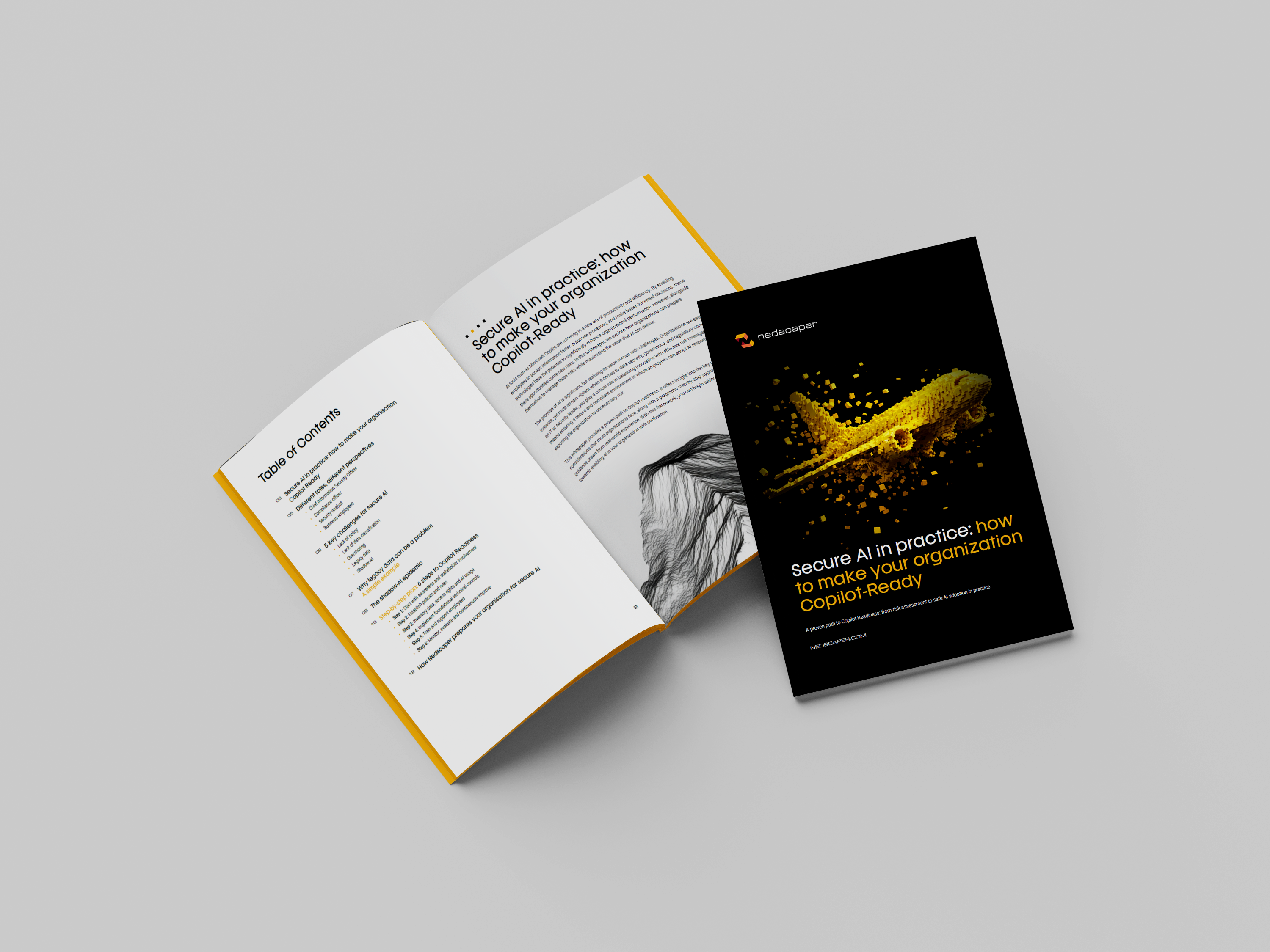
Download our Copilot-Readiness whitepaper
Discover the complete 6-step roadmap to Copilot Readiness.