The CISO at the center of the AI transition
The introduction of AI tools such as Microsoft Copilot presents organizations with major opportunities to increase productivity and work more intelligently. For the Chief Information Security Officer (CISO), however, this development also brings complex challenges.
The CISO must enable innovation while ensuring data security, compliance, and governance remain fully intact. Copilot changes the playing field: data becomes more widely accessible, AI functionality searches across an increasing number of sources, and the impact of a single misconfigured permission is greater than ever before.
Copilot data risks are structural, not incidental
For the CISO, managing AI risk goes far beyond securing the technology itself. The real challenge lies in protecting the data processed by AI tools. And this is where the greatest risk resides: AI uses all available information, including data that is outdated, inaccurate, sensitive, or improperly classified.
Many of the risks introduced by Copilot are familiar within security, but AI significantly amplifies their impact:
- Insufficient data classification
- Outdated or incorrect access rights
- Uncontrolled oversharing
- Legacy data containing sensitive information
- Lack of visibility into AI‑driven data processing
Copilot exposes these existing weaknesses and magnifies their consequences. For the CISO, it is essential to address these risks structurally, not reactively.
Why banning AI is not a strategy
Many CISOs recognize the instinctive response to restrict or temporarily ban new technologies. When it comes to AI, however, this approach is counterproductive.
Employees will use AI tools regardless. If Copilot is unavailable, they will turn to external alternatives, significantly increasing risk while reducing visibility and control.
The CISO who chooses to block AI unintentionally increases exposure.
The CISO who chooses to govern creates control.
The CISO as architect of a secure AI environment
A future‑proof AI strategy requires an integrated approach where policy, technology, and adoption work together. For the CISO, this means:
1. Creating awareness
Stakeholders must understand that AI is fundamentally different from traditional IT. It changes how data is found, shared, and processed. Without organizational buy‑in, no policy can be effectively enforced.
2. Establishing clear AI policy
AI policy should define:
- which AI tools are permitted
- which data classifications may or may not be used by AI
- how incidents are handled
- which roles are responsible for specific controls
3. Implementing technical controls
Examples include:
- SharePoint Advanced Management to exclude high‑risk sites
- Data Loss Prevention (DLP) to block sensitive information
- Monitoring via Microsoft Defender for Cloud Apps
- Mandatory classification of new documents
4. Training Employees in Safe Use
Prompting, responsible data usage, and risk awareness all directly influence the quality and security of AI output. Employees are a critical part of the control framework.
The CISO sets the pace, security, and success of AI adoption
A successful AI strategy requires leadership, vision, and governance. Organizations that invest now in policy, monitoring, and user enablement will be best positioned to adopt AI securely, without slowing down innovation.
Want to know how to approach this in a structured and practical way?
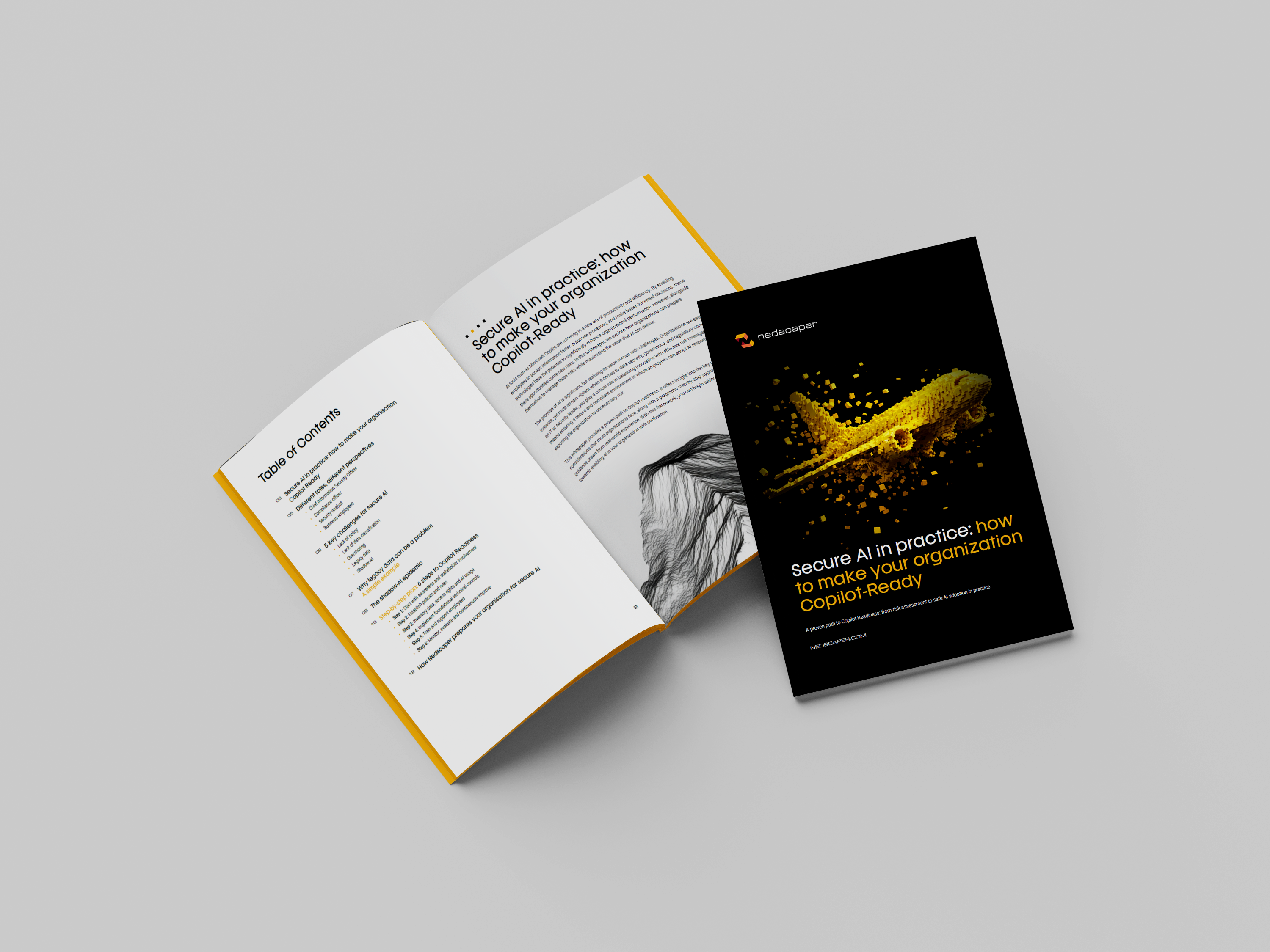
Download our Copilot-Readiness whitepaper
Discover the complete 6-step roadmap to Copilot Readiness.